
Why Some Parts Are Expensive
Why Some Parts Cost So Much.
It is probably one of the most common things that we are asked about some parts, "why is it so expensive?" and here we explain some of the common reasons.
The Background
To begin to understand a lot of why some parts are so expensive, you first need to have a little background in the production process.
You see, when a manufacturer is producing a machine, they will plan that production so, as a basic simple example, let's say that they will make 10,000 machines over a span of two years. They know that they need 10,000 of each unique part that's used in that machine and, they will also overorder so that they have spares for any warranty requirements normally.
Either internally or from an external supplier they know that they're going to use that and they can negotiate a price and so on in advance based on a huge order, even if it's over a period of time, meaning that suppliers etc. can get a great price on that bulk quantity.
Once that model goes out of production though, they will only need small batches of parts every now and then, unless it's a common item and/or one that breaks a lot!
For those smaller runs of parts, the setup costs, labour to do that and so on is far higher. Let's use out 10,000 number, if the setup and labour for that costs £1000 then it's £.010 per part. But if they only want a 1000 of that part, the setup costs shoot up to £1 per part. And that's before any material costs, components needed, and so on. It doesn't take much to double or more the end cost per unit over the original cost during mass production.
Where manufacturers use outside suppliers for parts and there's a lot they do that for, companies like Invensys, Askoll, Rold and many more face the same issue, when it's a bulk order they can use the economies of scale to get the prcie down but, when it's small batches, not so much, and the prices are much higher.
Same Part, Different Price
This is where we can really help people save a lot of parts.
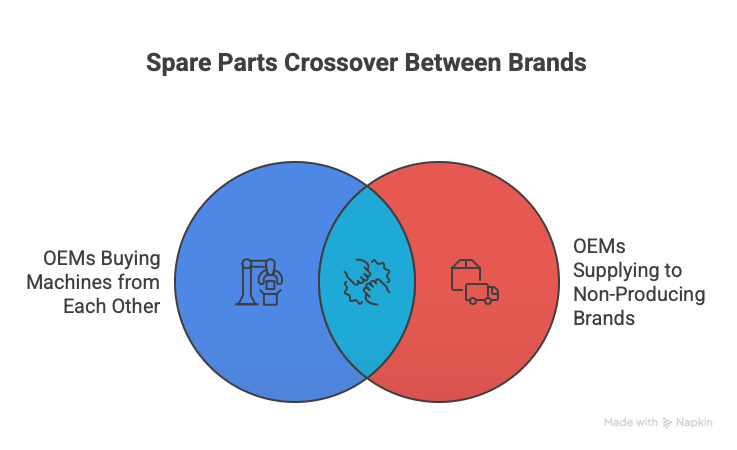
You will see this in various scenarios; we will look at the two most common ones.
- OEMs buying machines from each other
- OEMs supplying to brands that do not produce
OEM Brands
In the first case we will use the example of Bosch Neff Siemens (BSH Group) who bought a number of integrated washer dryers, branded for them and made by Smeg. Other than a few cosmetic alterations these machines are the same, they all use the same parts bar a few.
Yet a "genuine" door seal for one branded for BSH is over £100 and the genuine one supplied by Smeg, on a Smeg part number is roughly half the price.
The reason is that BSH has to buy those from Smeg, then repack them, put their part number sticker on it and all that stuff, which all costs money and that increases the price. For the same part.
Is it price gouging or something like that? We can't say, all we can do is try to work out why it happens so we can explain to people and, explain how they can save money on parts yet still get the "genuine" item.
This is pretty common in the industry and tends to happen with low volume (in our world) niche products that one manufacturer doesn't make but needs in their range. they don't spend millions and millions making a plant to produce those sorts of appliances; they buy them in from someone who does make them.
And that offers great opportunities to get savings for customers. If you can find this out.
All Branded Appliances
Then there are the brands that don't make anything at all, and there are a lot of those around.
It never ceases to surprise us how many people don't realise that brands that market themselves as being fantastic (of course, they say that,), selling "unique" appliances are not at all, they are just selling rebadged machines made by someone else, and they don't produce any machines at all.
Sure, they can affect the styling and some other minor tweaks, but on the whole, they can't alter much and almost never can alter the parts in the appliances.
You end up with producers that make machines for others, making them for several brands, so you can easily end up with ten or even twenty or more brands all using the same basic machines. All badged differently, at different prices and the parts prices are all over the place.
Many will try to hide that.
Which isn't a huge surprise given that a freezer flap, for example, depending on what brand you buy it from, could range from as little as £6 to £30. For the same plastic freezer flap.
Especially when we first encounter these types of parts, we put the work in, find out who uses it, where's the cheapest place to get it and then we pass that onto our customers.
The "Out There" Take
There is another thing or two we should mention as expensive spare parts have been doing the rounds lately, which explains why there are so many expensive assemblies.
Firstly, complete assemblies are "easier" for service techs to swap, especially if your technicians aren't that great. Basically, it's repairs for dummies, you just swap a complete unit over. It's also faster so it saves time and therefore money.
But the killer argument that it's hard to escape from is that those parts are only being paid for by insurers or service plan providers. No sane, ratiional normal person would pay over £200 to replace a tank in a £500 machine that's a few years old, an insurer doesn't have many options. The manufacturer and their own service isn't footing the bill, in fact, some will argue they profit down the road of the appliance's lifespan from this.
A conspiracy theory, perhaps. But it's not easy to dismiss.
Our Way
We've only scratched the surface here; there's a lot more to this than we've told you. We don't want to overload people with too much information.
We openly tell people all this (and more) as we have nothing to hide, and it helps people to understand how the industry works and why it's so complicated at times. Along with partly why we don't use AI (more here) because AI doesn't have that human gumption to know that even although the part numbers are different, the description may alter a bit and more that these parts are all the same thing.
It also helps customers to understand why it's often better with a number of parts to just ask us and let us do the work for you, we know what we're doing, looking at and where to look in order to get you the best outcome.